Financial markets are driven by two powerful emotions—fear and greed. Understanding how these emotions influence market behavior is essential for every investor.
The concept of market fear and opportunity in stock market investing becomes especially important during volatile times. When fear dominates, prices often fall—even if the underlying businesses remain strong. For informed investors, this can create valuable opportunities.
Understanding Fear and Greed in the Stock Market
When optimism dominates the market, investors tend to chase rising prices. This often leads to:
Overvaluation of stocks
Momentum-driven investing
Ignoring fundamentals
However, when uncertainty enters the market—due to geopolitical tensions, economic slowdown, or global instability—fear takes over.
This shift causes:
Panic selling
Sharp price corrections
Short-term volatility
 Why Market Fear Creates Opportunity in Stock Market
During periods of fear, stock prices may fall not because businesses are weak, but because investor sentiment has turned negative.
This aligns with the famous quote by Warren Buffett:
“Be fearful when others are greedy, and greedy when others are fearful.”
The idea behind market fear and opportunity in stock market is simple:
Fear leads to undervaluation
Undervaluation creates buying opportunities
Long-term investors benefit from patience
A Visible Opportunity in India’s Private Banking Sector
One of the best current examples of market fear and opportunity in stock market investing can be seen in India’s large private banks.
Banks are the backbone of a growing economy. While PSU banks delivered strong returns in recent years, much of that growth came from valuation re-rating after being undervalued.
Now, a similar setup is emerging in private sector banks.
These banks:
Have strong balance sheets
Maintain consistent growth
Possess long-term scalability
Yet, their stock prices have corrected due to market sentiment, not weak fundamentals.

Key Private Banks to Watch
HDFC Bank
ICICI Bank
Kotak Mahindra Bank
Current Valuation Snapshot
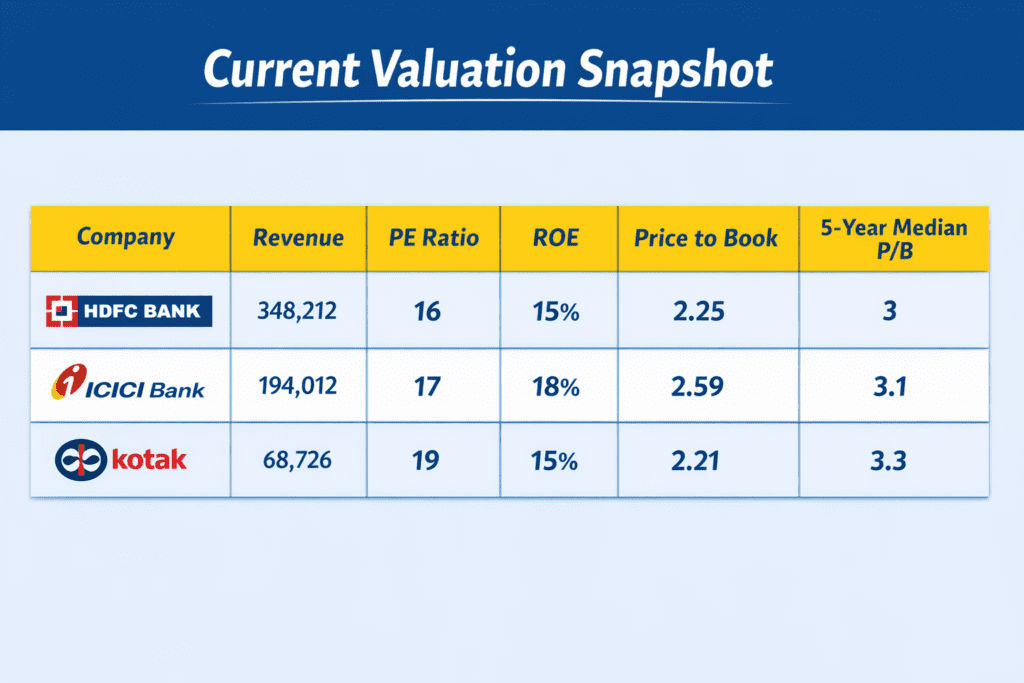
If we observe closely, all three banks are trading below their 5-year median Price-to-Book ratios.
This indicates:
Relatively attractive valuations
Potential for long-term upside
Opportunity for disciplined investors
Opportunity is Hidden in Volatility
Market corrections often create discomfort among investors. Falling prices trigger:
Doubt
Negative news flow
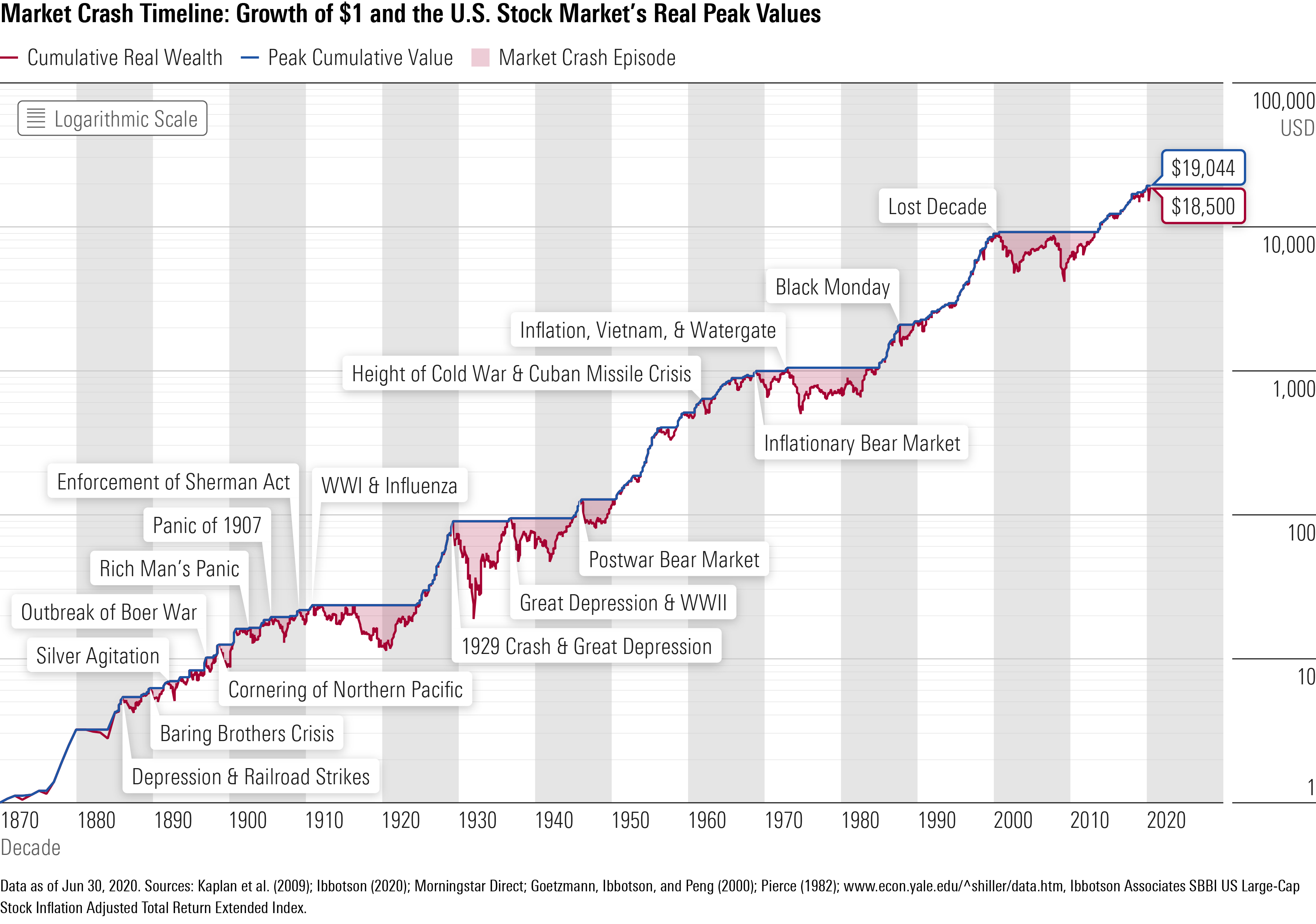
However, history shows that market fear and opportunity in stock market go hand in hand.
When greed dominates → investors overpay
When fear dominates → quality stocks become undervalued
For long-term investors who follow a disciplined value-investing approach, volatility is not a threat—it is an opportunity.
Final Thoughts
Geopolitical uncertainty and market volatility are inevitable. However, strong companies with solid fundamentals tend to survive and grow over time.
India’s leading private banks—HDFC Bank, ICICI Bank, and Kotak Mahindra Bank—have built strong foundations over decades.
The concept of market fear and opportunity in stock market reminds us that:
Opportunities often appear during uncertainty
Patience is key to long-term success
Smart investors act when others hesitate
The current market environment may feel uncertain, but for those who think long term, it could be one of those rare phases where opportunity quietly emerges.