
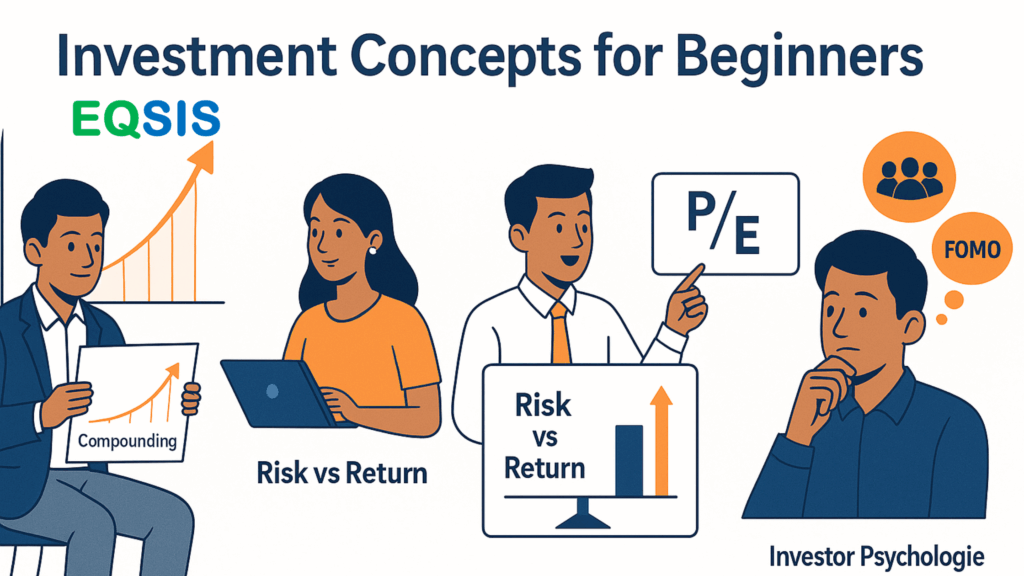
Understanding the right investment concepts for beginners is the first step towards becoming a confident investor. Starting your journey in the stock market can feel overwhelming. With too many opinions, unfamiliar terms, and confusing strategies everywhere, many beginners either avoid investing altogether or jump in blindly. But building wealth does not require complex formulas or years of expertise. What truly matters is understanding a few core principles that drive market behaviour, valuation, growth, and human decision-making.
Before choosing any stock, beginners must understand the basic ideas that influence long-term investing success. These concepts reduce emotional mistakes, bring clarity, and help you grow wealth steadily. Let’s break them down in the simplest way possible.
1. What Is Compounding and Why Does It Matter for Beginners?
Compounding is the process where your money earns returns, and then those returns start earning additional returns. Over time, this creates powerful exponential growth. For beginners, compounding is the strongest wealth-building tool because even small, consistent investments become significant when given enough time.
Example:
If you invest ₹3,000 per month at a 12% return:
-
After 5 years: You invest ₹1.8 lakh → it grows to ~₹2.5 lakh
-
After 10 years: You invest ₹3.6 lakh → it grows to ~₹7 lakh
-
After 20 years: You invest ₹7.2 lakh → it grows to ~₹30 lakh
The magic:
You invested ₹7.2 lakh, but compounding added ₹22–23 lakh extra on top of it.
Compounding starts slow, but the growth accelerates rapidly. That’s why starting early—even with small amounts—makes a massive difference.

2. How Should Beginners Understand Risk vs Return?
Every investment involves risk, and higher returns typically come with higher uncertainty. Low-risk instruments like FDs offer stable but limited returns, while equities offer higher wealth-building potential but come with short-term volatility.
Understanding this relationship helps beginners avoid the unrealistic expectation of “high returns with zero risk.”
Why this matters:
-
Stock prices go up and down in the short term
-
But historically, equity markets reward disciplined, long-term investors
-
Your personal risk appetite determines the right investment choices
Beginners who accept market fluctuations avoid panic selling and make more rational decisions.
3. What Is the PE Ratio and How Does It Help Evaluate Stocks?
The Price-to-Earnings (PE) ratio shows how expensive or cheap a stock is relative to its earnings. It’s one of the simplest valuation metrics for beginners.
Formula:
If a stock trades at ₹100 and its EPS is ₹10 → PE = 10
A high PE indicates either strong growth expectations or overvaluation. A low PE may mean undervaluation or weak growth prospects.
How beginners should use PE:
-
Never use PE alone
-
Compare it with companies in the same sector
-
Use it to identify whether a stock needs deeper research
PE is not a buy-or-sell signal — it simply helps you understand market expectations.
4. What Is Market Capitalization and Why Should Beginners Care?
Market Capitalization (Market Cap) shows the total value of a company in the stock market. It’s calculated as:
Share Price × Number of Outstanding Shares
Market cap helps beginners understand a company’s size, stability, and risk level.
Types of Companies:
-
Large-Cap: More stable, lower risk — ideal for beginners
-
Mid-Cap: Balanced risk and growth
-
Small-Cap: High growth potential but high volatility
Knowing market cap helps beginners choose investments aligned with their comfort level and long-term goals.
5. Why Understanding Human Biases Is Critical for Beginner Investors
Even the smartest investors make mistakes—not because of lack of knowledge, but because of emotions. Beginners commonly fall into mental traps such as:
-
Herd Bias: Buying because everyone else is
-
FOMO: Fear of missing out
-
Loss Aversion: Holding losing stocks too long
-
Overconfidence: Assuming wins are due to skill
-
Recency Bias: Believing recent trends will continue forever
Recognizing these biases helps beginners stay disciplined, follow a strategy, and avoid emotional decisions. Successful investing depends more on controlling your mind than predicting the market.
Conclusion
For anyone entering the stock market, understanding these five foundational concepts is more valuable than memorizing advanced formulas.
-
Compounding builds wealth
-
Risk-return sets expectations
-
PE ratio helps assess valuation
-
Market cap gives clarity on company size and stability
-
Awareness of biases helps you stay disciplined
Mastering these basics prepares beginners to invest confidently, avoid common mistakes, and build long-term wealth with clarity.
Frequently Asked Questions (FAQs)
1. How much money do I need to start investing?
You can start with as little as ₹500–₹1,000 per month through SIPs. Even buying a single share helps you begin. The key is consistency, not the amount.
2. Is compounding effective if I invest small amounts?
Absolutely. Compounding works best when you invest small amounts consistently over long periods.
3. Are stocks risky for beginners?
Stocks are volatile in the short term but provide strong long-term returns. Beginners can reduce risk by sticking to large-cap stocks or diversified equity funds.
4. How do I know if a stock is overpriced or cheap?
Use the PE ratio as an indicator. Compare it with the sector average for better clarity. Avoid relying on it alone.
5. Should beginners start with large-cap, mid-cap, or small-cap stocks?
Large-caps are safest for beginners. Mid-caps offer a good mix of growth and risk; small-caps should be approached later.
6. Why do beginners make emotional mistakes in the stock market?
Because decisions are influenced by fear, greed, FOMO, and herd behaviour. Knowing these biases helps avoid impulsive decisions.
7. Can I avoid risk completely while investing?
No. Every investment carries some risk. Your goal is to manage risk through diversification and long-term thinking.
8. How long should I stay invested to benefit from compounding?
Ideally 10–20 years or more. The longer you stay invested, the faster compounding accelerates.
9. Do I need to check my investments daily?
No. Daily checking triggers emotional decisions. Reviewing once a month or quarterly is enough.
10. What is the biggest mistake beginners make?
Expecting quick profits. Investing is a long-term journey, not a shortcut to get rich overnight.